Compounded Tirzepatide in 2026: What It Is and How It Works
Tirzepatide is a peptide that acts on two hormone receptors at once. Here is what compounded tirzepatide is, how it works, and why the pharmacy behind it matters most.

Compounded tirzepatide is a prescription peptide that a licensed physician orders and a state-licensed compounding pharmacy prepares for one named patient. Tirzepatide itself is a dual receptor agonist. It acts on both the GLP-1 and GIP receptors, two gut-hormone pathways that influence appetite, blood sugar, and how full you feel. The branded tirzepatide medicines are Mounjaro and Zepbound, made by Eli Lilly and approved by the FDA.
Compounded tirzepatide is a separate, individualized medication that is not FDA-approved, made to a prescriber's specifications for a specific person. The most important thing to understand in 2026 is not the molecule. It is who is behind it. A prescribed, pharmacy-grade medicine from a licensed doctor and a 503A pharmacy is a very different thing from a grey-market vial sold as "research only."
What compounded tirzepatide is
Compounded tirzepatide is tirzepatide prepared by a compounding pharmacy for one patient, based on a prescription written by a licensed physician. Compounding means a pharmacy makes a medication to fit a specific person rather than pulling a mass-manufactured box off a shelf. The result is a real, prescribed medicine. It is dispensed by a pharmacy and overseen by a prescriber.
How popular is Tirzepatide?People search for Tirzepatide about 825,000 times a month in the US, one of the most-searched peptides (2026 search data). See the Peptide Popularity Report for the full ranking.
Tirzepatide is a peptide. Peptides are short chains of amino acids that act as signals in the body, and tirzepatide is a synthetic peptide designed to bind two hormone receptors. That is why a peptide platform is a natural home for it. pru focuses only on peptides and closely related longevity therapies, so tirzepatide sits squarely in what we do.
THE SHORT VERSIONCompounded tirzepatide is a prescribed, pharmacy-made peptide for one patient. It is not the same product as Mounjaro or Zepbound, which are Eli Lilly's separate approved medicines.
How tirzepatide works as a dual GLP-1 and GIP peptide
Tirzepatide works by activating two receptors at once, which is what makes it different from single-target peptides. It is a dual agonist of the GLP-1 receptor and the GIP receptor. GLP-1 (glucagon-like peptide-1) and GIP (glucose-dependent insulinotropic polypeptide) are both incretin hormones, meaning they are released by the gut in response to food.
Through those two pathways, tirzepatide has been studied for several linked effects. It supports insulin release when blood sugar is high, slows how fast the stomach empties, and acts on appetite signaling in the brain. Together these may help you feel full sooner and stay full longer. Semaglutide, the other well-known peptide in this space, acts on the GLP-1 receptor alone. Tirzepatide adds the GIP pathway on top.
- GLP-1 receptor: influences insulin response, gastric emptying, and appetite signaling.
- GIP receptor: a second incretin pathway that tirzepatide also activates, which single-agonist peptides do not.
- Long acting: tirzepatide has a half-life of roughly five days, which is why it is dosed once a week.
- Studied in trials: Eli Lilly's SURPASS and SURMOUNT programs studied tirzepatide at 5 mg, 10 mg, and 15 mg weekly doses.
Describing the mechanism is not a promise of a result. How any one person responds depends on their body, their dose, their prescriber's plan, and their habits. Your physician decides whether tirzepatide is appropriate for you at all. To compare the two GLP-1 peptides side by side, see semaglutide vs tirzepatide.
How compounded tirzepatide is taken
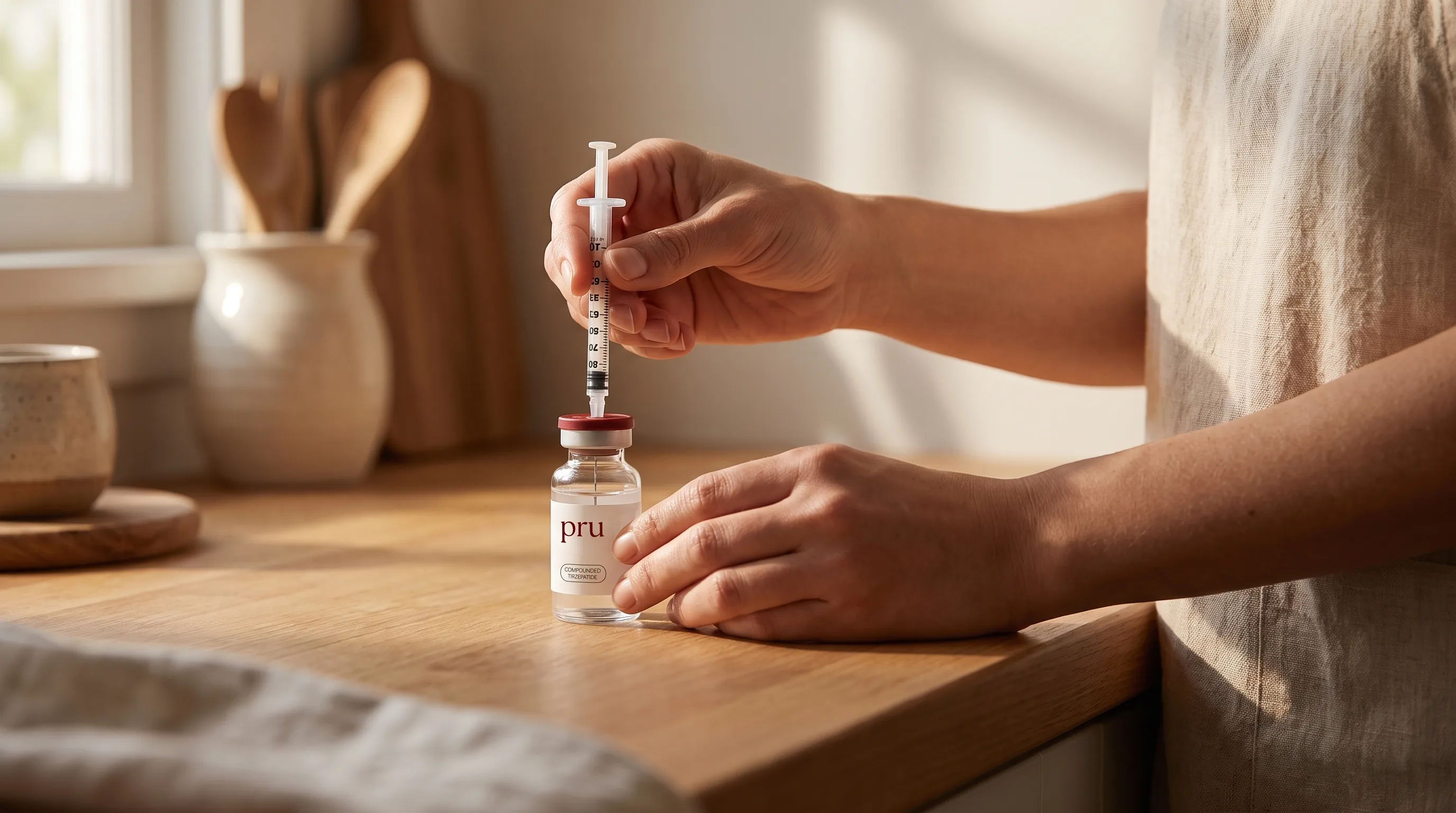
Compounded tirzepatide is a once-weekly injection given under the skin with a small insulin syringe. You inject subcutaneously, usually in the abdomen, thigh, or upper arm, on the same day each week. The dose starts low and steps up slowly over time, a process called titration, so your body has time to adjust and side effects stay manageable.
Your prescriber sets your exact schedule. The table below shows the standard escalation pattern used for branded tirzepatide, which prescribers often use as a reference point. Your compounded plan is individualized and may differ. For a fuller walkthrough, read the tirzepatide dosage guide.
| Phase | Weekly dose | Purpose |
|---|---|---|
| Weeks 1 to 4 | 2.5 mg | Starting dose, for initiation only |
| Weeks 5 to 8 | 5 mg | First step up and first maintenance option |
| After at least 4 weeks each | 7.5 mg, then 10 mg | Gradual increases in 2.5 mg steps |
| Higher maintenance | 12.5 mg, then 15 mg | Only if needed and tolerated; 15 mg is the maximum |
The most common side effects reported with tirzepatide are gastrointestinal, such as nausea, diarrhea, constipation, and stomach discomfort. They are usually mild to moderate and tend to ease as your body adjusts, which is exactly why the dose is raised slowly. Tell your prescriber about anything that concerns you, and never raise your own dose faster than your plan allows.
Pharmacy-grade tirzepatide versus research-grade vials
Pharmacy-grade compounded tirzepatide and grey-market research-grade vials are not the same thing, and this is the one place to be careful. Pharmacy-grade means the medicine is made by a licensed compounding pharmacy, prescribed by a physician for you by name, and dispensed with oversight. Research-grade means a vial sold online labeled research use only or not for human consumption, with no prescription, no prescriber, and no pharmacy accountability.
Those research-only vials are the real risk in this category. Because they sit outside the prescription system, no licensed pharmacy vouches for their identity, strength, or purity, and no physician is overseeing your use. Buying a peptide that way means you are guessing at what is in the vial and dosing yourself alone. The legitimate path is a prescription filled by a licensed pharmacy.
THE ONE THING TO GET RIGHTIf a tirzepatide vial is sold without a prescription and labeled research only, it is not a medicine and no pharmacy or doctor stands behind it. Pharmacy-grade means a licensed physician prescribes it and a state-licensed pharmacy fills it for you. That difference is the whole point.
Is compounded tirzepatide legal in 2026
Individualized 503A compounding of tirzepatide is legal in 2026 when it is done the right way. Under Section 503A of the federal Food, Drug, and Cosmetic Act, a state-licensed pharmacy can prepare a medication for a specific patient based on a valid prescription from a licensed prescriber. That patient-specific route is the legitimate path, and it is the path pru uses.
What changed is mass production. The FDA declared the tirzepatide shortage resolved in late 2024, and enforcement discretion for compounding tirzepatide ended in early 2025, with the deadline for state-licensed 503A pharmacies set for February 18, 2025.
In April 2026, the FDA also proposed leaving tirzepatide off the 503B bulks list, which would keep large outsourcing facilities from mass-compounding it from bulk drug substance. The takeaway is simple. Broad, one-size-fits-all copies are restricted. Individualized, prescription-based 503A compounding for a named patient remains the legitimate route, and it is the only kind pru offers.
503A versus 503B: which kind of compounding applies
There are two kinds of compounding pharmacy under federal law, and the difference decides what is legitimate for tirzepatide in 2026. A 503A pharmacy makes a medication for one named patient based on a specific prescription. A 503B facility, called an outsourcing facility, makes larger batches in advance, often without a prescription for each individual. Both are recognized under the federal Food, Drug, and Cosmetic Act, but they do different jobs.
| 503A pharmacy | 503B outsourcing facility | |
|---|---|---|
| Made for | One named patient, by prescription | Batches, often without a per-patient prescription |
| Best described as | Individualized, patient-specific | Larger-scale outsourcing |
| Tirzepatide in 2026 | Legitimate route pru uses | Restricted after the shortage resolved |
THE DISTINCTION THAT MATTERS503A is a pharmacy making your medicine for you, by prescription. 503B is a facility making batches. After the tirzepatide shortage resolved, mass copying was restricted, but individualized 503A compounding tied to your own prescription is still the legitimate path. That is the path pru uses.
Safety and how to choose a legitimate provider
If you are weighing compounded tirzepatide, you are already being proactive about your metabolic health, and that instinct is worth trusting. Choosing a legitimate provider comes down to a few things you can check, and they all point in the same direction: a real prescriber, a real pharmacy, and a medicine made correctly for you.
- A valid prescription: a licensed physician reviews your intake and decides whether tirzepatide is right for you before anything is dispensed.
- A state-licensed 503A pharmacy: your medicine is prepared for you by name at a licensed compounding pharmacy, not shipped from an anonymous seller.
- Dosing accuracy: your dose is set by your prescriber and prepared to those specifications, so you know exactly what you are drawing up each week.
- A Certificate of Analysis: a reputable pharmacy can document the identity, strength, and purity of what it dispenses, so the contents are verified rather than assumed.
- No research-grade vials: a legitimate provider never sells tirzepatide labeled research use only or not for human consumption. If a vial skips the prescription entirely, no pharmacy or physician stands behind it.
A quick outside signal helps too. LegitScript certification is an independent standard that vets telehealth and pharmacy operators for licensing and compliance, and it is a useful marker that a provider is running the legitimate way.
How pru handles compounded tirzepatide
pru handles compounded tirzepatide the legitimate way, through licensed physicians and state-licensed 503A compounding pharmacies. You complete an intake, a licensed physician reviews it and decides whether tirzepatide is appropriate and at what dose, and a 503A pharmacy fills the prescription for you by name. Nothing is sold without a prescriber in the loop.
Our pricing is where pru is different. A flat membership of about $50 a month, billed annually, funds the platform, and every peptide is priced at cost. We itemize what you pay, the pharmacy fill, the supplies, shipping, and the consult, with no markup on the medicine itself. You are not guessing whether a marked-up price is padding the medicine, because the medicine has no markup. See exactly how that works on pricing.
That is peptides made simple, for everyone. One membership, easy access, complete support, and transparent at-cost pricing. Taking charge of your metabolic health is a smart, responsible move, and pru exists to make that proactive choice the accessible one: licensed physicians, pharmacy-grade medicine, and at-cost pricing so the informed path is also the easy one.
Start with compounded tirzepatide, compare it with compounded semaglutide, or browse the full weight loss and metabolism category. To see how compounded tirzepatide differs from the branded medicines, read tirzepatide vs Mounjaro and Zepbound.
Related reading
- Where to buy compounded tirzepatide
- Compounded semaglutide, explained
- Where to buy compounded semaglutide
- Tirzepatide dosage and titration
- see it on pru
Common questions
Sources & further reading
- U.S. Food and Drug Administration. Zepbound (tirzepatide) injection prescribing information. accessdata.fda.gov.
- U.S. Food and Drug Administration. FDA clarifies policies for compounders as national GLP-1 supply begins to stabilize. fda.gov.
- U.S. Food and Drug Administration. Declaratory Order: Resolution of Shortages of Tirzepatide Injection Products. fda.gov.
- Frias JP, et al. Tirzepatide: a novel, first-in-class, dual GIP and GLP-1 receptor agonist. Journal of Diabetes and Its Complications / NCBI PMC.
- U.S. Food and Drug Administration. Compounding and the FD&C Act Sections 503A and 503B. fda.gov.
- LegitScript. Healthcare Merchant and Pharmacy Certification Standards. legitscript.com.
- United States Pharmacopeia. USP Compounding Standards and Certificate of Analysis guidance. usp.org.
- In U.S., GLP-1 Usage Reaches New High (Gallup, 2025): about 1 in 8 U.S. adults have used a GLP-1 medicine.