NAD+ Benefits in 2026: What the Science Actually Says
NAD+ is a coenzyme in every cell that fuels energy and DNA repair. Here's what the evidence supports, and how pru offers it at cost.
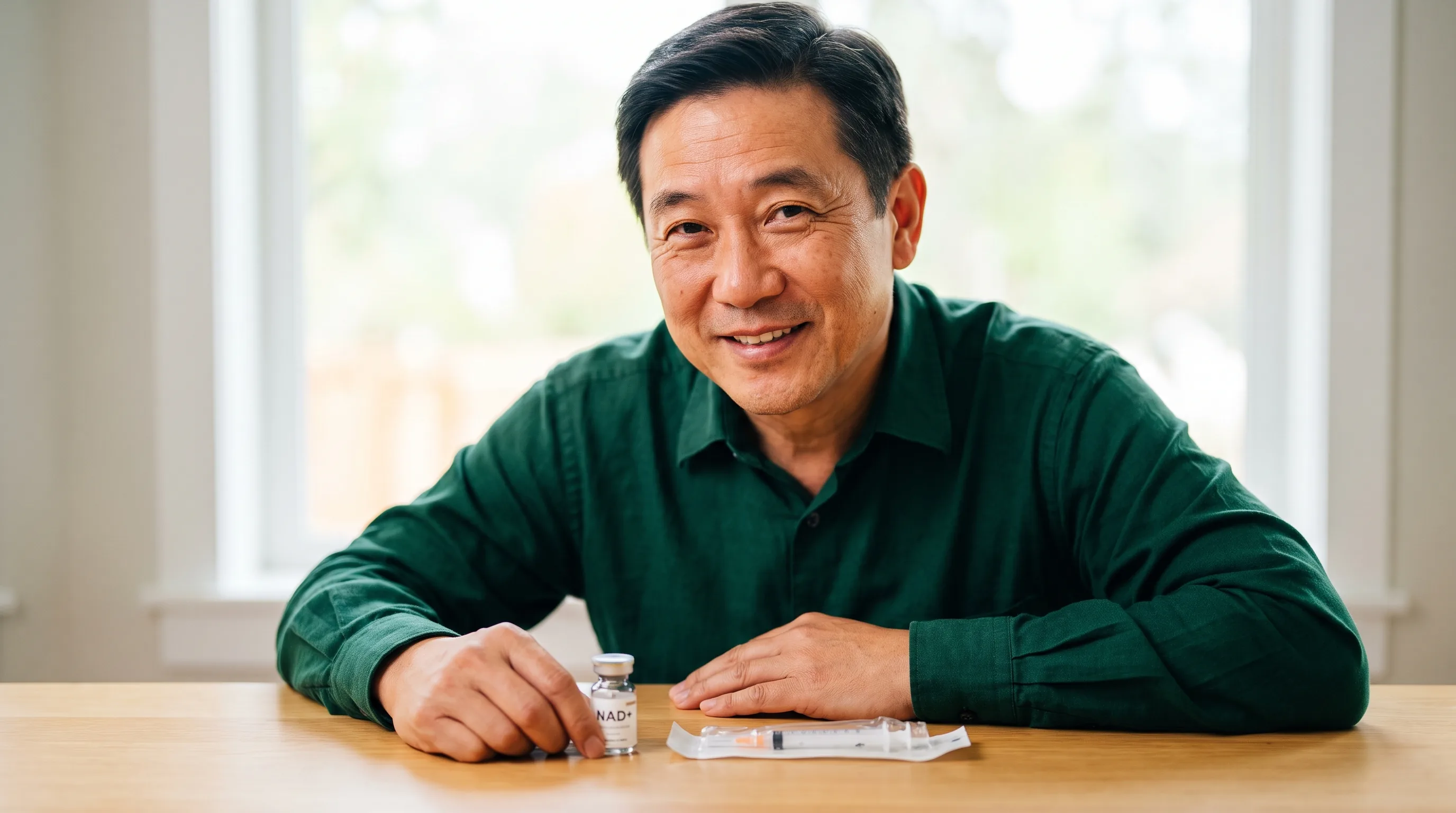
NAD+ (nicotinamide adenine dinucleotide) is a coenzyme found in every cell of your body. It helps turn food into energy and powers the enzymes that repair DNA and run the sirtuin longevity pathways. Levels fall as you age, which is why NAD+ has become a popular target for energy and healthy-aging routines.
NAD+ can be raised safely, and it is studied most in older adults, whose levels have declined. Below is what NAD+ is thought to do, how it is taken, and how pru dispenses it as a prescribed, at-home therapy priced at cost.
What is NAD+, and what does it do?
NAD+ is a coenzyme your cells use every second to convert food into usable energy. It shuttles electrons during metabolism to help make ATP, the fuel your mitochondria run on. Without enough NAD+, that energy process slows down.
How popular is NAD+?People search for NAD+ about 135,000 times a month in the US, one of the most-searched peptides (2026 search data). See the Peptide Popularity Report for the full ranking.
NAD+ also does more than power metabolism. It's the required fuel for two important enzyme families. PARP enzymes use NAD+ to repair damaged DNA, and sirtuins use it to regulate cellular stress, inflammation, and the pathways researchers link to healthy aging. When NAD+ runs low, both jobs get harder. That dual role, energy plus repair, is why it draws so much interest.
In one lineNAD+ is a coenzyme in every cell that helps make energy and powers your DNA-repair and longevity enzymes. It isn't a vitamin, a stimulant, or a hormone.
Why do NAD+ levels drop as you age?
NAD+ falls with age across species and across tissues, including liver, skin, brain, and muscle. Two things drive the drop. Your cells consume more NAD+ to deal with chronic inflammation and accumulated DNA damage, and at the same time they recycle it less efficiently. Over the years, consumption starts to outpace production.
This decline is the core reason NAD+ became a longevity target. The thinking is simple: if lower NAD+ tracks with aging, raising it back up supports the enzymes that depend on it. What the human evidence shows about restoring NAD+ is covered next.
What are the real, studied benefits of raising NAD+?
NAD+ can be raised safely in people, and it is studied most in older adults rather than healthy young ones. Here is what researchers have looked at.
- Energy and metabolism: NAD+ is thought to support physical function and sleep quality, and older-adult trials have looked at markers like walking pace and sleep.
- Healthy aging: NAD+ feeds the sirtuin and DNA-repair pathways tied to aging, and it is studied for its role in lower inflammatory markers in older adults.
- Cardiovascular markers: NAD+ is studied for its role in supporting healthy blood pressure and arterial flexibility in older adults.
- Skin and 'anti-aging' looks: NAD+ is studied for its role in the cellular repair pathways behind skin aging.
What to expectThe clearest benefits show up in older adults whose NAD+ has declined. Give any protocol a fair trial of 8 to 12 weeks before judging it.
How is NAD+ actually taken, and how do the options compare?
NAD+ can be delivered several ways, and they aren't equal on absorption, cost, or convenience. Swallowed NAD+ breaks down in digestion, so oral products use precursors like NMN and NR that your body converts toward NAD+. Bypassing the gut (IV, injection, or nasal) gets NAD+ in more directly. Here's the plain comparison.
| Option | What it is | How it's taken | Absorption note | pru availability |
|---|---|---|---|---|
| Oral NMN / NR | NAD+ precursors your body converts | Capsules or powder at home | Convenient, but how well precursors raise NAD+ is debated | Not offered by pru |
| In-clinic IV drip | NAD+ infused directly into a vein | Long sessions at a wellness clinic | Direct delivery, but expensive and in-person | Not offered by pru |
| 'Research-grade' vials | Unregulated NAD+ sold with no clinician | Self-mixed and self-injected | No oversight, no quality guarantee, real safety risk | Never. This is the risk to avoid |
| Prescribed at-home injection or nasal | Individualized, pharmacy-grade NAD+ | Small subcutaneous shot or nasal spray at home | Direct delivery without a clinic visit | Yes. pru's lane, prescribed and at cost |
The short version: oral precursors are easy but their conversion is debated, IV drips deliver well but cost a lot and require a clinic, and unregulated research vials are the genuinely risky choice because no clinician stands behind them. A prescribed at-home injection or nasal spray aims to combine direct delivery with the safety of real oversight.
Is NAD+ safe, and what are the common side effects?
In trials, NAD+ has been raised safely, and serious reactions are rare when it's dosed properly under a clinician. Its main side effects are noticeable but usually short-lived. The most common is a flushing sensation, sometimes with head or chest pressure or brief nausea during and shortly after a dose, often lasting 15 to 45 minutes.
- Dose in the morning, and ramp up gradually rather than starting high.
- Going slower during the dose, or splitting it, usually eases flushing and nausea.
- Injections can cause soreness or redness at the site.
- Long-term human safety data is still limited, which is another reason clinician oversight matters.
Because long-term data is thin, NAD+ should be started under a licensed physician who reviews your history first. It's a therapy to titrate carefully, not to megadose. Note that NAD+ is not on the WADA prohibited list, so it isn't banned for tested athletes on that basis.
NAD+ delivery methods, compared
How you take NAD+ changes how much reaches your cells. NAD+ is a large, charged molecule, so an oral capsule survives the gut poorly. Injected and nasal routes bypass the gut and reach the bloodstream more directly, and an IV drip delivers the most at once. The tradeoff is convenience and setting: IV means a clinic visit, while injection and nasal are done at home.
| Route | How it is taken | Reaches the bloodstream | Setting |
|---|---|---|---|
| IV drip | Infused over 1 to 2+ hours | Highest, all at once | In-clinic |
| Injection (subcutaneous) | Small at-home injection | High, bypasses the gut | At home |
| Nasal spray | Absorbed through nasal lining | Moderate, bypasses the gut | At home |
| Oral capsule / precursor | Swallowed | Low, mostly broken down in the gut | At home |
pru dispenses NAD+ as a prescribed, 503A-compounded medicine in two at-home routes: a subcutaneous injection and a nasal option. That keeps the direct absorption of a needle-based route, or the needle-free ease of nasal, without a clinic visit. It is different from a research-grade vial you dose yourself, and different from an in-clinic drip.
Prescribed, not the same as a supplementpru's NAD+ is pharmacy-grade and compounded by an FDA-regulated 503A pharmacy against a prescription from a licensed physician. That is a separate thing from an over-the-counter NAD+ or NR/NMN capsule you buy off a shelf.

NAD+ vs NR and NMN: what is the difference?
NAD+ is the coenzyme your cells actually use. NR (nicotinamide riboside) and NMN (nicotinamide mononucleotide) are precursors, the raw materials your body converts into NAD+. Most oral longevity supplements sell NR or NMN rather than NAD+ itself, because precursors are somewhat easier to absorb by mouth.
- NAD+: the finished coenzyme used directly in energy and DNA-repair reactions.
- NR / NMN: precursors that your body must convert into NAD+ first.
- In human trials, two weeks of oral NR or NMN can roughly double circulating NAD+, though much of an oral dose is broken down in the gut before it is absorbed.
pru's NAD+ is the coenzyme itself, delivered by injection or nasal spray so it does not have to be absorbed through the gut the way an oral precursor is. If you have seen NR or NMN supplements online, those are a related but different product category from a prescribed, compounded NAD+ medicine.
Who NAD+ is for, and who should be cautious
NAD+ is generally studied in adults interested in energy, recovery, and healthy aging, and it is studied most in older adults, whose NAD+ levels have declined.
Some people should not start NAD+ without a clinician's sign-off. Providers commonly hold off or advise against it if you are pregnant or breastfeeding, have active or untreated cancer, or have significant kidney, liver, or uncontrolled cardiovascular conditions. With pru, a licensed physician reviews your intake and history before anything is prescribed, so these questions are handled up front rather than left to you.
How pru handles thisEvery pru therapy is prescription-only. A licensed physician reviews your intake first, and NAD+ is dispensed by an FDA-regulated 503A pharmacy only if it is appropriate for you. See membership and pricing for what is included.
What to expect: side effects and timeline
NAD+ is generally well tolerated in the human studies published to date. The most common effects are mild and pass quickly. With faster routes like IV or injection, some people notice temporary flushing, nausea, a warm feeling, or a mild headache, which usually ease when the dose goes in more slowly.
- Common, temporary: flushing, warmth, mild nausea, or a brief headache, more likely with faster delivery.
- Timeline: any changes people report tend to build over weeks of consistent use rather than after a single dose.
- Scope: NAD+ is studied for energy, recovery, and healthy aging.
Because pru's NAD+ is prescribed and pharmacy-grade, your physician sets the route and dose for you and can adjust if a route does not sit well. That is a different experience from self-dosing a research-grade vial with no clinical oversight.
How does pru handle NAD+?
pru is a telehealth platform focused only on peptides and closely related longevity therapies. We partner with licensed physicians and licensed 503A compounding pharmacies. If NAD+ is appropriate for you, a licensed physician reviews your intake and, when suitable, writes an individualized prescription. The pharmacy compounds it as a pharmacy-grade product and ships it to your door.
You take it at home. pru offers NAD+ as a small subcutaneous injection or as a nasal spray, so you skip both the long clinic IV session and the guesswork of unregulated 'research-grade' vials that come with no clinician at all. It's dispensed as an individualized 503A compounded prescription, which is not the same as an FDA-approved drug. NAD+ is not a controlled substance and isn't on the WADA prohibited list.
How the pricing worksA flat membership of about $50/mo funds the platform. Every therapy is priced at cost and itemized, so there's no markup on the medicine itself. You see exactly what the NAD+ costs the pharmacy. Compare that to in-clinic IV drips that can run hundreds of dollars per session.
Getting ahead of how your cells age is a smart, proactive move, and pru exists to make that informed choice the accessible one: licensed physicians, pharmacy-grade NAD+, and at-cost pricing on one path. If you want to go deeper, read NAD+ dosage for a titration walk-through, compare delivery in NAD+ injection vs IV vs oral, and see how it differs from precursors in NMN vs NAD+. When you're ready, take the next step and see the NAD+ therapy page or browse the full catalog.
Related reading
Common questions
Sources & further reading
- NAD+ in Regenerative Medicine (PMC / NIH), pmc.ncbi.nlm.nih.gov: PMC9512238
- What Is an NAD Supplement? (Cleveland Clinic), health.clevelandclinic.org: Nad Supplement
- Chronic NR supplementation elevates NAD+ in older adults (PMC / NIH), ncbi.nlm.nih.gov: PMC5876407
- Safety of NMN oral administration in healthy adults (PMC / NIH), ncbi.nlm.nih.gov: PMC9400576
- pru NAD+ therapy, joinpru.com/shop/product/nad
- NAD+ Therapeutics and Skeletal Muscle Adaptation to Exercise in Humans, PMC (PMC9734213); human NAD+ studies are most relevant in aging and metabolic contexts.
- NAD+ Precursors Nicotinamide Mononucleotide (NMN) and Nicotinamide Riboside (NR): Potential Dietary Contribution to Health, PMC (PMC10240123); oral NR/NMN bioavailability is poor and much is broken down in the gut before absorption.
- Oral Administration of Nicotinamide Mononucleotide Is Safe and Efficiently Increases Blood NAD Levels in Healthy Subjects, PMC (PMC9036060); oral NR/NMN can roughly double circulating NAD+ over ~2 weeks.
- NAD+ Injectable Solution and Nasal Spray, joinpru.com (/shop/product/nad); pru dispenses NAD+ as a prescribed, 503A-compounded at-home injection and nasal option.