Anti-Aging Peptides in 2026: What They Are and What the Evidence Really Shows
A complete guide to the peptides studied for longevity, what the research shows, and how to get the ones pru offers safely.
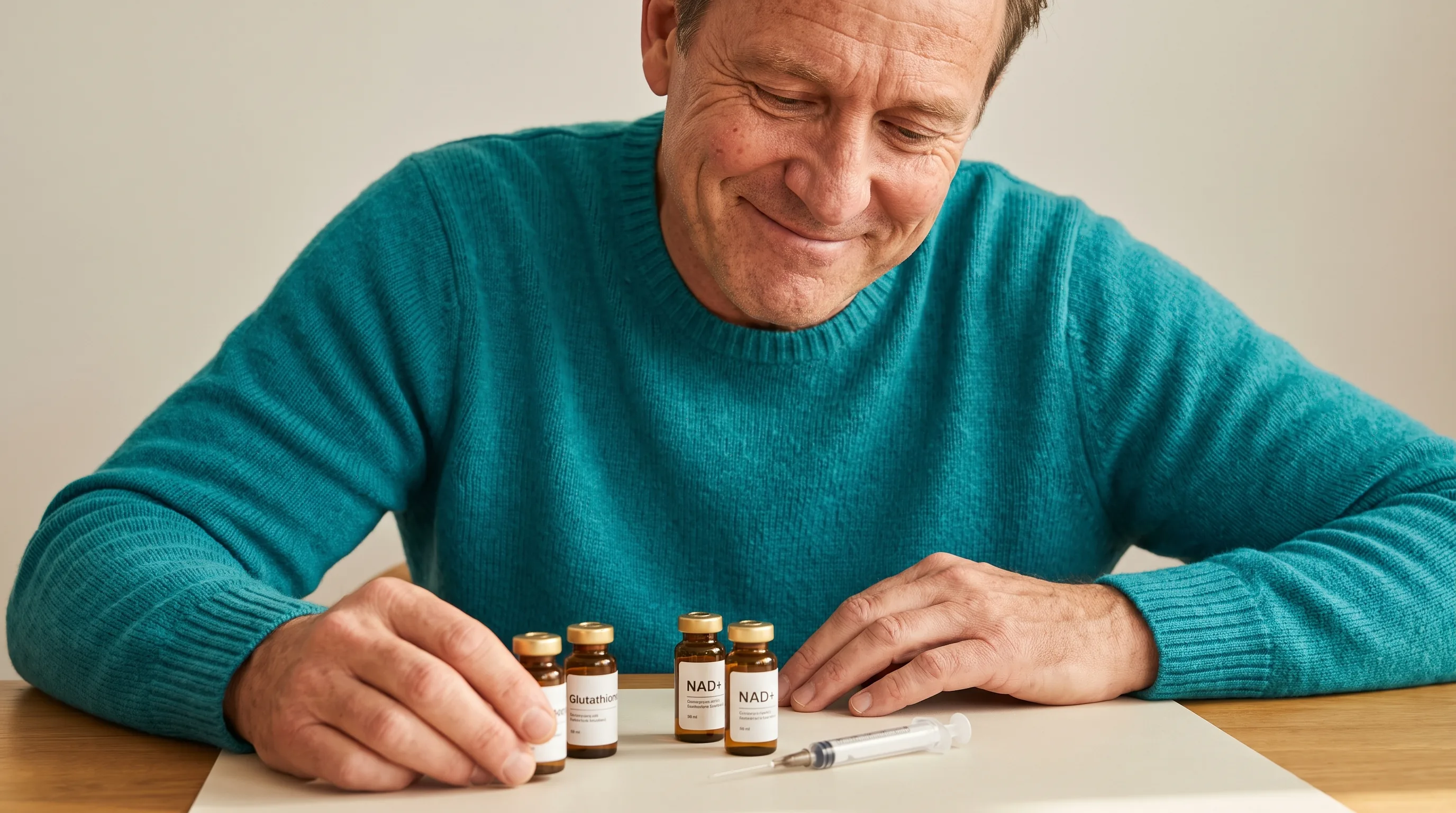
Anti-aging peptides are short chains of amino acids that the body uses to signal repair, fight free radicals, and fuel its cells. Some are studied for skin, energy, and healthy aging. pru offers the best-studied of these today, led by NAD+ and glutathione as prescribed, pharmacy-grade, at-home injections, priced at cost. This guide covers what these peptides are, how they work, what the research shows, and how to get them without the risks of the unregulated market.
Anti-aging peptides are short amino-acid chains the body uses as signals
A peptide is a short string of amino acids, the same building blocks that make proteins. Your body already makes thousands of them to carry messages between cells. "Anti-aging peptides" is an umbrella term for the ones people take to support skin, cellular energy, and repair as they get older. They range from cosmetic ingredients to prescribed injectables, and the evidence behind each one varies.
You'll see a lot of names in this space. Here's what the common ones are studied for, so the field is easy to map.
- GHK-Cu (a copper peptide): studied for collagen and skin repair.
- Epithalon: studied for telomeres and longevity.
- MOTS-C: a mitochondrial-derived peptide studied for metabolism and how cells make energy.
- Thymosin alpha-1: studied for immune balance, which shifts with age.
- Sermorelin, CJC-1295, and ipamorelin: growth-hormone peptides studied for recovery, sleep, and body composition with age.
- BPC-157 and TB-500: studied for tissue repair.
- Glutathione: the body's main antioxidant, a tripeptide of three amino acids.
- NAD+: a coenzyme that fuels DNA repair and the sirtuin longevity pathways, and that falls with age.
Today, pru offers NAD+ and glutathione as its core longevity injectables, well-characterized molecules a licensed physician and pharmacy can dispense responsibly, plus GHK-Cu as a topical cream. pru is excited to add more of these longevity peptides, like epithalon, MOTS-C, and thymosin alpha-1, as the FDA's Pharmacy Compounding Advisory Committee review settles, so it can offer them the safest and most effective way.
The anti-aging peptides people ask about most, one by one
Beyond NAD+ and glutathione, a handful of peptides drive most of the consumer interest in longevity. Here is what each is studied for. pru does not offer the planned ones yet, and that is deliberate: it adds a peptide only once there is a safe, prescribed pathway with an FDA-registered 503A pharmacy behind it, and several of these are moving through that review now.
| Peptide | What it is studied for | Where it stands |
|---|---|---|
| Epitalon | Telomere and pineal signaling | Planned (July 2026 PCAC) |
| MOTS-c | Mitochondrial energy and metabolism | Planned (July 2026 PCAC) |
| Thymosin alpha-1 | Immune balance | Planned |
| FOXO4-DRI | Clearing senescent cells | Planned |
| NMN | Oral NAD+ precursor | pru offers NAD+ directly |
| NAD+ | Cellular-energy coenzyme | Offered now |
| Glutathione | Master antioxidant | Offered now |
Epitalon is a synthetic version of a pineal-gland peptide, studied for activating telomerase, the enzyme that maintains the protective caps on your chromosomes, and for steadying melatonin and circadian rhythm.
MOTS-c is a mitochondrial-derived peptide, studied for how cells produce and use energy and respond to exercise and metabolic stress.
Thymosin alpha-1 is a peptide from the thymus, studied for balancing immune function, which tends to weaken with age.
FOXO4-DRI is an experimental senolytic peptide, designed to nudge senescent, or worn-out, cells to clear themselves, which improved several markers of aging in animal studies.
NMN is an oral molecule your body converts into NAD+, popular as a longevity supplement. pru offers NAD+ directly.
Topical peptides like GHK-Cu target the skin from the outside
A big share of the "anti-aging peptides" people search for are cosmetic, applied to the skin rather than injected. These are the ones you'll see in serums and creams, studied for collagen, firmness, and fine lines. They act on the surface, so their evidence base and their risk profile are different from the injectables covered below.
- GHK-Cu (copper peptide): the most-studied topical, examined for collagen synthesis, skin repair, and firmness.
- Argireline (acetyl hexapeptide-8): studied for the look of expression lines.
- Matrixyl (palmitoyl peptides): studied for collagen support and skin texture.
- Collagen peptides: taken orally or applied topically and studied for skin hydration and elasticity.
pru offers GHK-Cu today as a topical cream, the delivery route with the deepest cosmetic research behind it. pru plans to add GHK-Cu as an injectable once physician oversight and an FDA-regulated 503A pharmacy pathway are in place, so it can offer that route done right rather than as a research-grade vial. If your goal is skin first, a topical peptide is often the sensible starting point before anything injected.
They work by fighting oxidative damage and fueling the cell's repair machinery
Aging at the cell level involves two big themes: oxidative stress, where reactive molecules damage tissue over time, and a slow drop in the fuel and signals cells use to repair themselves. Anti-aging peptides are studied because they touch these pathways. Different peptides act through collagen synthesis, antioxidant activity, mitochondrial support, or DNA repair. The two pru offers each hit a different lever.
Glutathione (GSH) is the body's master antioxidant. It neutralizes free radicals directly, recycles vitamins C and E so they can keep working, and supports the liver's normal detox pathways. It also dampens the enzyme that drives melanin production, which is the basis for its reputation as a skin-brightening agent.
NAD+ (nicotinamide adenine dinucleotide) is a coenzyme that acts like cellular fuel. It powers the enzymes that repair DNA and the sirtuin pathways tied to longevity and metabolism. NAD+ levels fall as we age, which is why raising them has become a focus of longevity research. NMN and NR are oral precursors the body converts toward NAD+. pru offers NAD+ directly, as an injection or nasal spray, rather than a precursor.
What the human research shows for glutathione and NAD+
The broader field is well catalogued in the research literature. Databases like AgingBase map hundreds of anti-aging peptides and the evidence tier behind each, and the picture is uneven: many names common in online forums, including epithalon and MOTS-C, still rest largely on cell and animal work, while a handful carry human trials. That evidence bar is the reason pru narrows to two.
The two molecules pru offers are among the better-studied in this space, with human research behind them, not just cell and animal work.
- NAD+: Human trials show NAD+ can be raised safely, and reviews point to gains in endurance, metabolic markers, and fatigue, studied most in older adults.
- Glutathione: A well-established antioxidant, thought to support a brighter, more even skin tone, with trial support across oral and topical forms.
- Both are studied as real biological tools for antioxidant support and cellular energy.
pru's position is simple. These are well-studied molecules worth using with a clinician, studied for the uses above and not a treatment for any disease.
How you take a peptide changes both absorption and risk
Anti-aging peptides reach the body three main ways, and the route matters. Oral supplements are convenient but absorption is limited and debated, since the gut breaks many peptides down. In-clinic IV drips deliver the dose effectively but are expensive and require an appointment each time. Subcutaneous injection, a small shot under the skin at home, gets the molecule into the body reliably without a clinic visit. NAD+ can also be given as a nasal spray.
The biggest safety issue in this space isn't the molecules. It's where people get them. "Research-grade" vials sold online with a "not for human use" label come with no clinician, no prescription, and no guarantee of what's actually inside. That's the real risk: mislabeling and contamination, plus the hazards of self-injecting a product no one vetted.
Used properly, glutathione and NAD+ have manageable, well-known effects.
- Glutathione: The main issue is injection-site reactions. It's avoided in pregnancy and breastfeeding, kept refrigerated and out of light, and not given in the same line as NAD+ at the same time.
- NAD+: A too-fast dose can cause flushing, head or chest pressure, and brief nausea during and for 15 to 45 minutes after. Dosing in the morning, ramping up slowly, and splitting the dose keep it comfortable. Give it 8 to 12 weeks to judge.
- Neither glutathione nor NAD+ is a controlled substance, and neither is on the WADA prohibited list.
Glutathione and NAD+ compared side by side
| Glutathione | NAD+ | |
|---|---|---|
| What it is | The body's main antioxidant, a tripeptide of three amino acids | A coenzyme that fuels DNA repair and sirtuin longevity pathways |
| Mechanism | Neutralizes free radicals, recycles vitamins C and E, supports liver detox, dampens the melanin enzyme | Refuels the enzymes behind DNA repair and metabolism; levels fall with age |
| Studied for | Antioxidant support and a brighter, more even skin tone | Endurance, metabolic, and fatigue support, studied most in older adults |
| How pru gives it | At-home subcutaneous injection | At-home subcutaneous injection or nasal spray |
| Evidence | Well-established antioxidant; thought to support a brighter, more even skin tone | Can be raised safely; benefits studied most in older adults |
| pru availability | Prescribed, 503A-compounded, at cost | Prescribed, 503A-compounded, at cost |
NAD+ vs NMN comes up a lot here. NMN and NR are oral precursors your body has to convert. pru offers NAD+ directly, prescribed, so you're not relying on that conversion step or on the debated absorption of a pill.
Give it 8 to 12 weeks to judge the change
Most anti-aging peptides work gradually, so plan to notice changes over weeks, not days. Human trials of NAD+ and its precursors typically run 4 to 12 weeks, and that window is a fair yardstick for what to expect. Judge the change over that time, not after the first few doses.
- First 1 to 2 weeks: your body is taking the molecule in, and any effect builds from there.
- Weeks 2 to 6: where some people report a lift in energy or steadier stamina with NAD+.
- Weeks 8 to 12: the fair point to judge whether it is helping you. For glutathione, any skin-brightening effect is gradual and builds over this window.
- A clinician can help you read the change at 12 weeks and decide whether to continue.
pru's clinicians set this timeline with you up front. You can read the fuller picture on how NAD+ works and what the trials show.

Whether to combine glutathione and NAD+ is a clinical decision, not a stacking hack
You will see the online peptide world talk about "stacking," layering several peptides at once for a bigger effect. It is worth being careful here. Combining unvetted molecules from research-grade vials multiplies the risk of contamination and interaction. pru does not treat this as a build-your-own exercise.
Glutathione and NAD+ are sometimes used together because they act on different levers, one an antioxidant, the other cellular fuel. When they are, the sequencing matters for practical reasons.
- Glutathione and NAD+ are not given in the same line at the same time. They are typically spaced or given as separate injections.
- NAD+ is eased in slowly and often taken in the morning, since a too-fast dose can cause flushing or brief nausea.
- Any combination should be reviewed by the prescribing physician against your history, not self-assembled from what you read online.
You choose the therapies you want, guided by pru, and a licensed physician confirms whether combining them is appropriate for you (or advises against it) and sets the schedule and dose. That is the safe version of "stacking": a clinician-reviewed plan using two well-characterized molecules, not a pile of unverified vials. You can see how the two compare in the glutathione vs NAD+ breakdown.
These fit healthy adults focused on aging support, and some people should hold off
Anti-aging peptides are not for everyone, and a good program starts by confirming fit. glutathione and NAD+ tend to make the most sense for healthy adults, often over 40, who want antioxidant or cellular-energy support. A physician confirms fit during intake rather than selling to everyone.
A few situations call for waiting or skipping these, and the intake review exists to catch exactly this.
- Pregnancy and breastfeeding: glutathione and NAD+ are generally avoided.
- An active or unstable medical condition, or a complex medication list: raise it, since it may change what is appropriate.
- People who would be self-injecting an unvetted research-grade vial: that is the higher-risk path this whole category warns against, whoever you are.
The intake is the gateWith pru, a licensed physician reviews your history before anything is dispensed. If glutathione or NAD+ is not right for you, the answer is no, not a workaround.
If you think you are a fit, choosing to be proactive about your aging is worth trusting, and you can see the two therapies in the cellular health catalog or check membership and at-cost pricing first.
pru dispenses glutathione and NAD+ as prescribed, at-home injections priced at cost
pru is a telehealth platform focused only on peptides and closely related longevity therapies. We partner with licensed physicians and licensed 503A compounding pharmacies. A physician reviews your intake, and if it's appropriate, your glutathione or NAD+ is prepared as an individualized 503A compounded prescription and shipped to you as an at-home subcutaneous injection. NAD+ is also available as a nasal spray. It's pharmacy-grade and prescribed, not a research-grade vial off a website.
That model is built to fix the three problems with the alternatives. It replaces unregulated online vials with a clinician and a licensed pharmacy. It skips the limited, debated absorption of oral supplements by delivering the molecule directly. And it gives you the effective delivery of an IV drip without the cost or the clinic visit, since you dose at home.
How pricing worksA flat membership of about $50 a month funds the platform. Every therapy is priced at cost and itemized, with no markup on the medicine itself. You see what the pharmacy charges, and that's what you pay.
That's the whole idea: prescribed, pharmacy-grade, at home, and at cost. Getting ahead of how you age is a smart, responsible move, and pru exists to make that proactive choice the accessible one, so the informed path is also the easy one. When you are ready to take the next step, browse the full peptide catalog, see NAD+, or check exact membership and at-cost pricing.
Related reading
- Glutathione benefits
- Glutathione dosage
- Glutathione side effects
- Glutathione vs NAD+
- browse the full catalog
Common questions
Sources & further reading
- AgingBase: a comprehensive database of anti-aging peptides, PMC (National Library of Medicine)
- NAD+ supplementation for anti-aging and wellness: a PRISMA-guided systematic review of preclinical and clinical evidence, ScienceDirect
- Glutathione as a skin whitening agent: facts, myths, evidence and controversies, Indian Journal of Dermatology, Venereology and Leprology (PubMed)
- Exploring the Safety and Efficacy of Glutathione Supplementation for Skin Lightening: A Narrative Review, PMC (National Library of Medicine)
- Glutathione and NAD+ therapies, joinpru.com
- Improved Physical Performance Parameters in Patients Taking Nicotinamide Mononucleotide (NMN): A Systematic Review of Randomized Control Trials, PMC (National Library of Medicine)
- Chronic nicotinamide riboside supplementation is well-tolerated and elevates NAD+ in healthy middle-aged and older adults, PMC (National Library of Medicine)