Bacteriostatic Water for Peptides: The Complete 2026 Guide
What bac water is, how it differs from sterile water, and how to use it safely.

Bacteriostatic water is sterile water with 0.9% benzyl alcohol added as a preservative. That small amount of benzyl alcohol stops bacteria from growing, so you can draw from the same peptide vial many times over roughly 28 days. Plain sterile water has no preservative and is meant for a single use. For most reconstituted peptides, bacteriostatic water is the standard diluent. Your pru pharmacy label and prescriber's instructions always come first.
Bacteriostatic water for peptides, in one line
Bacteriostatic water (often called bac water) is the liquid you mix into a freeze-dried peptide vial to turn the powder into an injectable solution. It is sterile water plus 0.9% benzyl alcohol, a preservative that lets you reuse the vial over several weeks instead of just once.
If you get your peptides through pru, your 503A pharmacy usually supplies the right diluent and a label that tells you how much to add. This page explains the why behind that so you can prepare each dose with confidence. For the step-by-step, see how to reconstitute peptides.
The short versionBac water = sterile water + 0.9% benzyl alcohol. The preservative means multiple safe draws for up to about 28 days. Sterile water has no preservative and is single-use.
What is bacteriostatic water?
Bacteriostatic water is sterile water for injection with 0.9% benzyl alcohol added as a preservative. By weight that is 9 mg of benzyl alcohol per milliliter. Everything else is water.
The word bacteriostatic means it holds bacteria back. Benzyl alcohol disrupts bacterial cell membranes, so once you puncture the vial and start drawing doses, stray microbes that get in are kept from multiplying. That is what makes a multi-dose peptide vial practical: you can reconstitute once and inject over many days from the same vial.
- Sterile water base, made for injection
- 0.9% benzyl alcohol (9 mg/mL) as the preservative
- Supplied in multi-dose vials meant to be entered many times
- The standard diluent for most peptides that come as a powder
Bacteriostatic water vs sterile water
The one difference that matters is the preservative. Bacteriostatic water contains benzyl alcohol and can be reused; sterile water for injection has no preservative and is single-use. Both are sterile when sealed, but only bac water stays safe for repeated draws.
| Feature | Bacteriostatic water | Sterile water for injection |
|---|---|---|
| Preservative | 0.9% benzyl alcohol (9 mg/mL) | None |
| Reuse after first puncture | Multiple draws over days | Single use only |
| Typical in-use window | Up to about 28 days once opened | Discard after one use |
| Best for | Multi-dose peptide vials | Single-dose prep; newborns |
| Not suited for | Newborns and infants | Reuse over multiple days |
Because peptide vials usually last well beyond a single injection, bac water is the default choice. Sterile water shows up mainly when a preservative must be avoided, such as care for newborns or when a prescriber specifies it.
Why peptides need bacteriostatic water
Peptides need bac water because they ship as a dry powder and have to be dissolved before use. Most peptides are freeze-dried (lyophilized) so they stay stable in storage and shipping. Adding a sterile liquid rebuilds them into a solution you can measure and inject.
Bac water is preferred over plain sterile water for a simple reason: a typical vial holds enough for many doses across several weeks, and the preservative keeps that vial usable the whole time. The 0.9% benzyl alcohol is enough to hold back most bacteria and fungi without disrupting the dissolved peptide.
Related stepReconstitution is only half the process. Once mixed, learn to measure the dose in the right units before you inject: see insulin syringe units explained and how to inject peptides subcutaneously.
How much bacteriostatic water to add
The amount of bac water you add sets the concentration, not the total dose. The peptide milligrams in the vial stay the same no matter how much water you use; more water simply spreads that same amount across a larger volume, which changes how many units you draw per dose.
There is no single correct volume. Your pru pharmacy label and prescriber's instructions define the right amount for your vial. The table below shows how the math works so the numbers on your label make sense.
| Water added | Peptide in vial | Resulting concentration |
|---|---|---|
| 1 mL | 5 mg | 5 mg per mL |
| 2 mL | 5 mg | 2.5 mg per mL |
| 1 mL | 10 mg | 10 mg per mL |
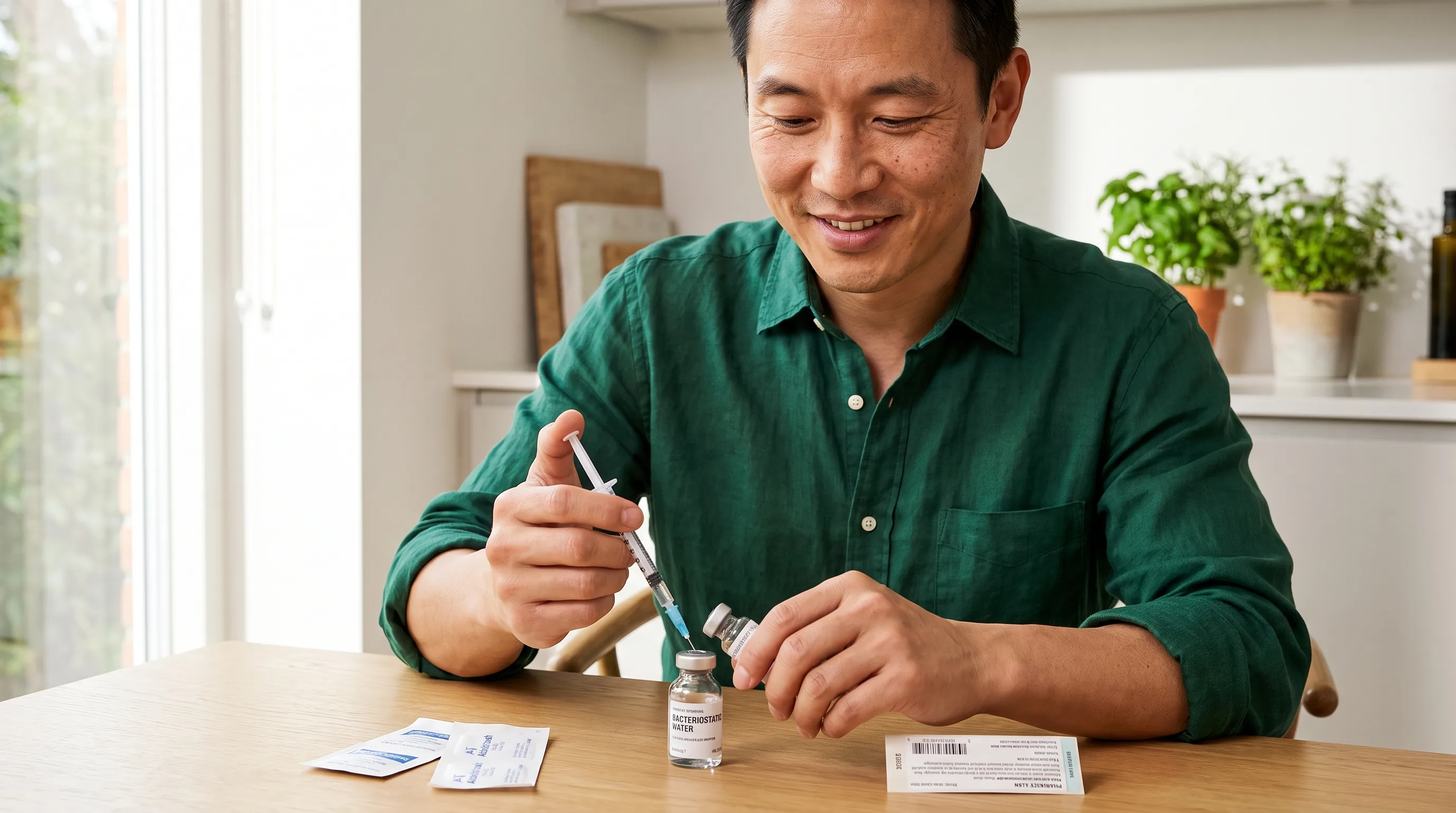
Add the water slowly down the inside wall of the vial rather than blasting it onto the powder, then let it dissolve without shaking. The full technique is in how to reconstitute peptides.
Storing bac water and staying safe
Store a reconstituted vial in the refrigerator, keep it out of light, and plan to use it within the in-use window. For a multi-dose vial preserved with benzyl alcohol, that window is commonly up to about 28 days once punctured, unless your label says otherwise. See how to store peptides for cold-chain details.
- Swab the vial stopper with alcohol before every draw
- Use a fresh, sterile needle each time
- Refrigerate after mixing and note the date you opened it
- Do not use if the solution looks cloudy, colored, or has particles
Important safety noteBacteriostatic water is not for newborns or premature infants. The benzyl alcohol preservative has been linked to a serious condition in neonates known as gasping syndrome, which is why the FDA advised against benzyl alcohol in newborn products back in 1982. For infants, a prescriber uses preservative-free sterile water instead.
For most adults using a prescribed, pharmacy-made peptide, the small amount of benzyl alcohol in bac water is well tolerated. If you have a known benzyl alcohol sensitivity, tell your prescriber.
Why the source of your water and peptide matters
The biggest safety question is not bac water versus sterile water. It is whether the vial in your hand came from a licensed pharmacy or from the grey market. Both your peptide and your diluent should be pharmacy-grade, made and labeled for human use.
Vials sold online as research-grade or not for human use skip the parts that keep injections safe: no prescriber, no pharmacy, and no verified identity, purity, or sterility. That is the real risk, and it is a different thing from prescribed, pharmacy-made peptides. Read research-grade vs pharmacy-grade peptides and how to verify a peptide source.
On regulation: compounded peptides are not FDA-approved, which is normal for compounded medicines. A 503A pharmacy legally compounds prescribed medicines that are not themselves FDA-approved. Here's the exciting part: on April 15, 2026 the FDA removed 12 peptides from the 503A Category 2 list, and its advisory committee (PCAC) reviews 7 of them, including BPC-157 and TB-500, on July 23 to 24, 2026.
Keep the shape of it in mind, though. PCAC only recommends; the FDA decides on its own over the months that follow. So removal from Category 2 isn't approval, and it isn't a spot on the authorized 503A list yet. The door is opening, it just isn't open yet, and pru is getting ready to offer these the right way the moment the path is real. See FDA peptide regulations 2026.
How pru handles peptides and their diluent
pru keeps the whole path legitimate so you are never sourcing vials or water from the grey market. A licensed physician reviews your intake and confirms clinical fit, an FDA-regulated 503A pharmacy compounds and fills your prescription, and your peptides are billed at cost with no markup on a roughly $50 per month membership.
- Licensed physician prescribes; you select, the physician confirms fit
- 503A pharmacy compounds, fills, and supplies the correct diluent
- A Certificate of Analysis comes with every order
- Peptides billed at cost, itemized, no markup
That means the bac water, the vial, and the label all come from one accountable source. Learning to prepare each dose right is part of taking charge of your health, and pru exists to make that careful, informed path the accessible one. When you are ready to take the next step, explore what pru offers in the catalog, see membership pricing, or learn how to start peptide therapy.
Related reading
Keep going with these guides on prepping, dosing, and sourcing peptides safely.
- How to reconstitute peptides
- How to inject peptides subcutaneously
- Insulin syringe units explained
- How to store peptides
- Research-grade vs pharmacy-grade peptides
- What is a 503A pharmacy
- Browse the pru catalog