How to Reconstitute Peptides: A Complete Step-by-Step Guide for 2026
What bacteriostatic water is, how to mix a vial without ruining it, and how to turn milligrams into the right number of units on an insulin syringe.
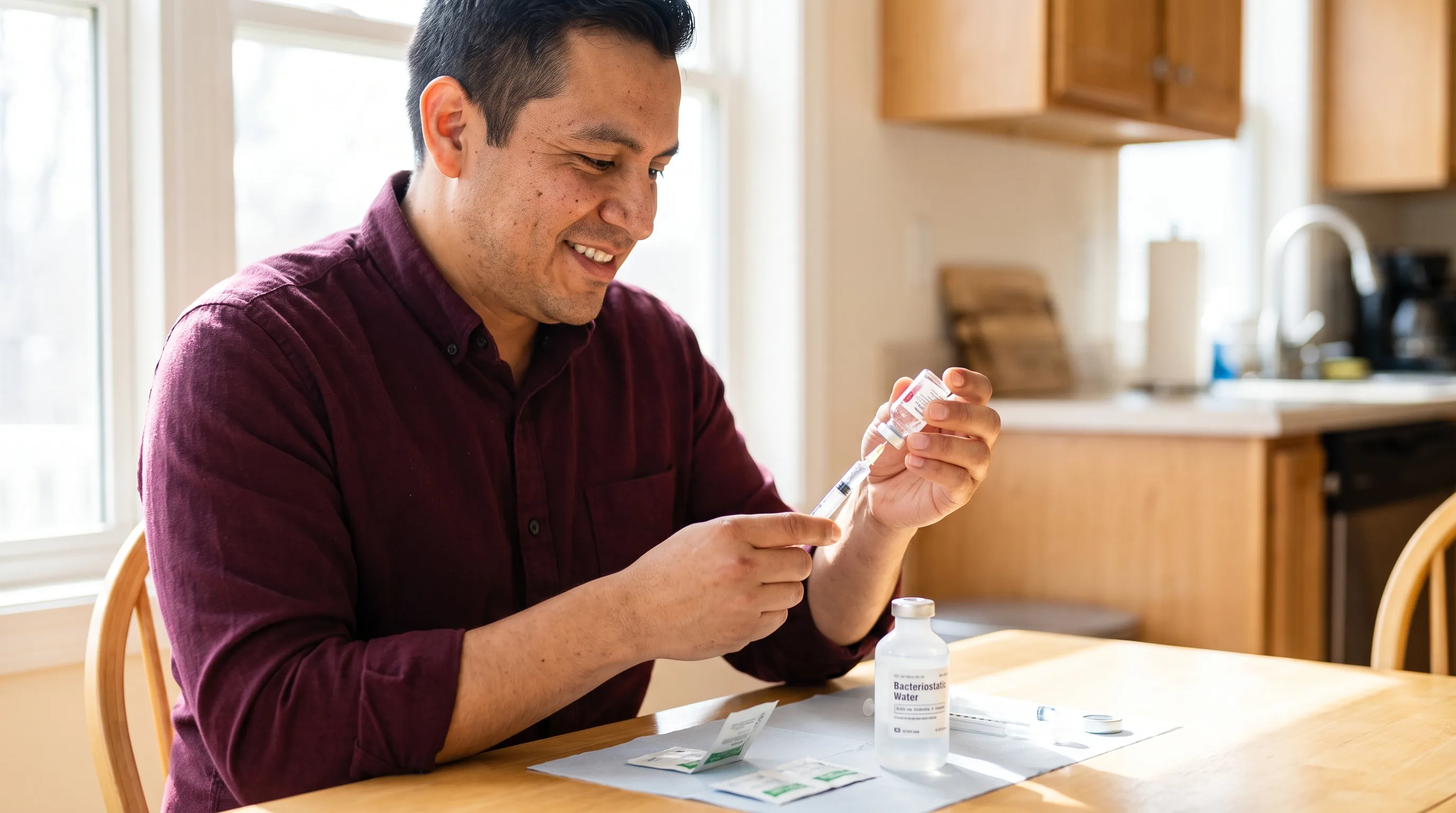
To reconstitute peptides, you add bacteriostatic water to a vial of freeze-dried peptide powder so it becomes a liquid you can measure and inject. Clean both vial tops with alcohol, draw the exact amount of water your pharmacy specifies, add it slowly down the vial wall, and swirl gently until clear. Then store it cold. Always follow the dilution and dose your prescriber and 503a pharmacy give you.
How to reconstitute peptides, step by step
Reconstituting a peptide means turning dry powder into an injectable liquid by adding sterile water. The powder is lyophilized (freeze-dried) so it stays stable in shipping; you mix it right before use. Here is the short version, then the details are below.
- Wipe the top of both the peptide vial and the bacteriostatic water vial with a fresh alcohol swab.
- Draw the exact amount of bacteriostatic water your pharmacy specifies into a reconstitution syringe.
- Add the water slowly, aiming the stream down the inside wall of the peptide vial, not straight onto the powder.
- Swirl or roll the vial gently until the liquid is clear. Do not shake hard.
- Label it with the date, then store it in the fridge and draw each dose with an insulin syringe.
Follow your pharmacy's instructionsYour prescriber and 503a pharmacy tell you how much water to add and how much to draw. The steps here explain the how and why; your prescription sets the exact numbers.
What reconstitution actually means
Reconstitution means rehydrating a dry peptide so you can dose it. Many peptides are shipped as a lyophilized powder because a dry powder is far more stable than a liquid during transit and storage. Adding bacteriostatic water dissolves that powder into a measured solution.
You are not changing the medicine, only mixing it. The amount of peptide in the vial does not change when you add water. What changes is the concentration, meaning how many milligrams of peptide sit in each milliliter of liquid. That number is what lets you draw an accurate dose. For a deeper look at the water itself, see the bacteriostatic water guide.
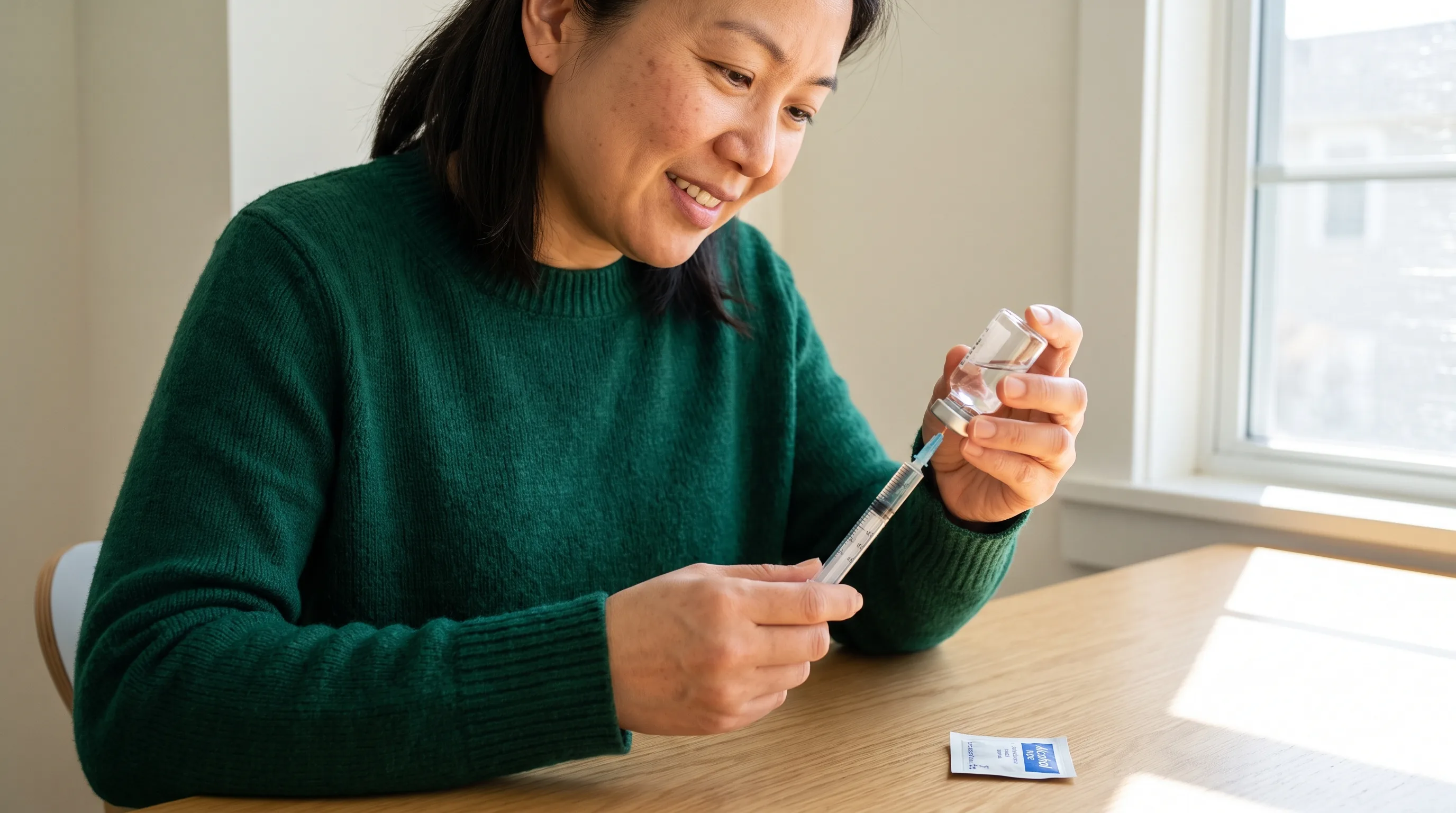
What you need to reconstitute a peptide
You need six things to reconstitute a peptide cleanly. Most come from your pharmacy or are easy to buy sterile. The goal is one clean pass with as few punctures as possible.
| Item | What it does |
|---|---|
| Peptide vial (lyophilized powder) | The prescribed peptide from your 503a pharmacy |
| Bacteriostatic water | Sterile diluent with 0.9% benzyl alcohol; lets one vial be used across many doses |
| Reconstitution syringe (about 3 mL, 23-25 gauge) | Draws and adds the water in a single pass |
| Insulin syringe (U-100, 0.3-0.5 mL, 29-31 gauge) | Draws and injects each individual dose |
| Alcohol wipes | Clean every vial stopper before each puncture |
| Sharps container | Safe disposal of used needles |
Bacteriostatic water is not the same as plain sterile water or saline. It contains 0.9% (9 mg/mL) benzyl alcohol as a preservative, which is what allows a mixed vial to be drawn from repeatedly over several weeks in the fridge.
The full step-by-step reconstitution process
Here is the careful, full process. Clean technique matters more than speed. Every puncture is a chance to introduce bacteria, so wipe stoppers every time and work on a clean surface.
- Wash your hands and lay out supplies on a clean, dry surface.
- Flip the plastic cap off each vial and wipe both rubber stoppers with a fresh alcohol swab. Let them dry.
- Pull air into the reconstitution syringe equal to the water you plan to draw, then inject that air into the bacteriostatic water vial to make withdrawal easy.
- Draw the exact amount of bacteriostatic water your pharmacy specified.
- Insert the needle into the peptide vial and push the water in slowly, letting it run down the inside wall rather than blasting the powder.
- Remove the syringe and swirl or gently roll the vial. Give it a minute; the powder usually dissolves into a clear solution. Do not shake vigorously.
- If anything looks cloudy, gritty, or discolored, do not use it and contact your pharmacy.
- Write the reconstitution date on the vial and refrigerate it.
Add the water, do not force the powderPeptides are delicate. A slow stream down the vial wall and a gentle swirl protect the molecule. Hard shaking can degrade some peptides and creates foam that makes dosing harder.
How to calculate concentration and dose
Concentration is the whole point of the math. The formula is simple: divide the milligrams of peptide by the milliliters of water you add. That gives milligrams per milliliter (mg/mL), which tells you how much peptide is in each unit of liquid.
Example: a 5 mg vial plus 2 mL of bacteriostatic water gives 2.5 mg/mL. If your prescribed dose is 250 mcg (which is 0.25 mg), you divide 0.25 by 2.5 to get 0.1 mL. On a U-100 insulin syringe, 1 mL equals 100 units, so 0.1 mL is 10 units. A so-called peptide reconstitution calculator does exactly this arithmetic for you, but the logic above is all it is doing.
| Vial size | Water added | Concentration | Example dose | Volume to draw | Units (U-100) |
|---|---|---|---|---|---|
| 5 mg | 2 mL | 2.5 mg/mL | 250 mcg | 0.10 mL | 10 units |
| 5 mg | 1 mL | 5 mg/mL | 250 mcg | 0.05 mL | 5 units |
| 10 mg | 2 mL | 5 mg/mL | 500 mcg | 0.10 mL | 10 units |
| 10 mg | 1 mL | 10 mg/mL | 1 mg | 0.10 mL | 10 units |
More water makes a weaker, easier-to-measure solution; less water makes it stronger and lower-volume. This is why your dilution has to match your dose. For help reading the syringe itself, see the insulin syringe units guide.
How to read your dose in insulin units
Most peptide doses are drawn on a U-100 insulin syringe, where the barrel is marked in units, not milliliters. The single rule to memorize: 100 units equals 1 mL. So 50 units is 0.5 mL, 20 units is 0.2 mL, and 10 units is 0.1 mL.
Working in units avoids decimal-point mistakes with tiny volumes. Once you know your concentration, convert your dose to units once, write it down, and draw the same number every time. Learn the injection itself in how to inject peptides subcutaneously.
How to store a reconstituted vial
Once mixed, a peptide vial goes in the refrigerator, not the freezer. Freezing a reconstituted peptide can damage it. Keep it at 2-8°C, protected from light, and draw doses without contaminating the stopper.
- Refrigerate at 2-8°C right after mixing; never freeze a reconstituted vial.
- Wipe the stopper with alcohol before every draw.
- Most reconstituted peptides are used within about 28 days, but follow your pharmacy's exact beyond-use date.
- Keep unmixed (lyophilized) vials as your pharmacy directs, often refrigerated or frozen until you reconstitute.
Your pharmacy assigns a beyond-use date based on the specific peptide and diluent. That date, not a general rule of thumb, is what governs your vial. See how to store peptides for the full breakdown.
Why pharmacy-grade vials matter for reconstitution
Reconstitution technique only protects you if what is in the vial is real. The biggest safety risk in peptides is not compounding; it is grey-market vials sold as research-grade or not for human use. Those come with no prescriber, no verified pharmacy, and no confirmed identity, purity, or sterility.
A pharmacy-grade compounded peptide is different. It is prescribed by a licensed physician and made by an FDA-regulated 503a pharmacy, which compounds a medicine for one patient's prescription. Compounded peptides are not FDA-approved, and that is normal: 503a pharmacies legally compound prescribed medicines that are not themselves FDA-approved products. Not approved is not the same as unsafe when a licensed prescriber and a regulated pharmacy stand behind it. Compare the two in research-grade vs pharmacy-grade peptides.
2026 regulatory noteThis is an exciting moment for peptides. On April 15, 2026 the FDA removed 12 peptides from the 503a Category 2 list, and on July 23-24, 2026 its Pharmacy Compounding Advisory Committee (PCAC) reviews 7 of them (BPC-157, TB-500, KPV, MOTS-C, DSIP, Semax, Epitalon).
Keep its shape in mind: PCAC only recommends, the FDA decides on its own over the months that follow, and a yes is not approval and does not by itself add a peptide to the 503a list. The door is opening, not open yet. See FDA peptide regulations 2026.
How pru handles reconstitution and quality
Learning to reconstitute a vial carefully is a proactive step in owning your own health, and pru is built so the vial you take that care with is one you can trust. A licensed physician confirms fit, an FDA-regulated 503a pharmacy compounds and fills the prescription, and each order ships with dosing guidance so the mixing and unit math above are spelled out for your specific peptide.
- Physician-prescribed: you select the peptide guided by pru's education; a licensed physician confirms clinical fit.
- 503a pharmacy-grade: prescriptions are compounded and filled by an FDA-regulated 503a pharmacy, not sold as research vials.
- Certificate of Analysis: every order includes a CoA, so you can verify identity and purity of what you are reconstituting. Learn to read one in how to read a peptide certificate of analysis.
- At cost: peptides are itemized at cost with no markup on a roughly $50/mo membership. See pricing.
You can browse the categories on the catalog, from muscle and performance to repair and regeneration, or read up on specific options like sermorelin. What is a 503a pharmacy, exactly? Start with what is a 503a pharmacy. If you are ready to take that next step, pru exists to make the informed, careful choice the accessible one, with licensed physicians, pharmacy-grade medicine, and at-cost pricing.
Related reading
Keep learning the hands-on basics and the trust questions behind them:
- Bacteriostatic water guide
- How to inject peptides subcutaneously
- Insulin syringe units guide
- How to store peptides
- Research-grade vs pharmacy-grade peptides
- Browse the pru catalog