How to Inject Peptides Subcutaneously: A 2026 Step-by-Step Guide
What subcutaneous means, the supplies you need, where and how to inject, and how to keep every step clean and safe.

Subcutaneous injection puts a small dose of reconstituted peptide into the fat layer just under your skin, using a thin insulin syringe. Clean your hands and the vial, draw your dose, pinch a clean site on your abdomen, thigh, or upper arm, insert the needle at 45 to 90 degrees, push slowly, and put the needle in a sharps container. Always follow the exact dose and instructions your prescriber and pharmacy gave you.
How to inject peptides subcutaneously, in short
A subcutaneous (subq) injection places medicine in the soft fat layer between your skin and muscle. For peptides this is usually a tiny volume drawn into a thin insulin syringe. The core steps are the same every time: wash up, prep the vial and skin, draw the exact dose, inject at 45 to 90 degrees into a clean rotated site, then dispose of the needle safely.
- Wash your hands and work on a clean, dry surface.
- Wipe the vial stopper and your chosen skin site with a fresh alcohol pad and let both air-dry.
- Draw the exact prescribed dose into an insulin syringe and tap out air bubbles.
- Pinch a fold of skin on the abdomen, thigh, or upper arm and insert the needle.
- Push the plunger slowly, remove the needle, and drop it straight into a sharps container.
Read this firstUse only the peptide, dose, and technique your prescriber and pharmacy gave you, and follow the printed label that comes with your medication.
What a subcutaneous injection actually is
Subcutaneous means "under the skin." The subcutaneous layer sits between the dermis (your skin) and the muscle below it, and it is made mostly of fat with a loose web of small blood vessels. Those vessels absorb the peptide slowly into your bloodstream, which is why most reconstituted peptides are given this way rather than into muscle or a vein.
Subq is different from intramuscular (IM), which goes deeper into muscle, and from intravenous (IV), which goes into a vein. Subq uses a much shorter, thinner needle and is the standard route for the peptides pru's prescribing physicians work with. If your prescriber ever wants a different route, they will tell you directly. For the reconstitution step that comes before injecting, see how to reconstitute peptides.
The supplies you need for a subq peptide injection
You need very little, but each item matters. Most subq peptide doses are tiny (often 0.05 to 0.5 mL), so an insulin syringe with fine unit markings makes measuring accurate and the stick nearly painless.
| Item | Typical spec | Why it matters |
|---|---|---|
| Insulin syringe | 28 to 31 gauge, 0.5 in (½ cc / 1 cc) | Thin needle, fine unit markings for small, precise doses |
| Alcohol pads | 70% isopropyl | Cleans the vial stopper and skin to lower infection risk |
| Your reconstituted vial | Peptide mixed with bacteriostatic water | The prepared medicine; store per label |
| Sharps container | FDA-cleared or rigid, puncture-proof | Safe, legal disposal of used needles |
| Clean, dry surface | Wiped tabletop or tray | Keeps everything sterile during prep |
A 29 to 31 gauge needle is thin enough that most people describe the stick as a light pinch. If you are unsure how insulin syringe markings translate to your dose, read the insulin syringe units guide, and for mixing basics see the bacteriostatic water guide.
Never reuse a needleUse a fresh syringe and needle for every single injection. A reused needle dulls fast, hurts more, and raises infection risk.
Where to give a subcutaneous peptide injection
The best subq sites have a comfortable layer of fat and are easy to reach. The abdomen is the most common site because the fat depth is consistent and the area is large enough to rotate. The outer thigh and the back of the upper arm are good alternates.
| Site | Where exactly | Notes |
|---|---|---|
| Abdomen | Around the belly, staying about 2 inches away from the navel | Most common; consistent fat, easy to see and rotate |
| Outer thigh | Front-outer thigh, between hip and knee | Good self-inject spot; pinch a fold first |
| Upper arm | Back of the upper arm, over the fat pad | Often easier with help; harder to reach yourself |
Skip any spot that is bruised, red, hard, scarred, tender, or close to a mole, vein, or your navel. Pick a fresh clean site each time within your chosen area.
Step-by-step: how to do a subq injection
Here is the full sequence once your vial is already reconstituted. Move slowly and do not rush the clean-up steps; sterility is what keeps this safe.
- 1. Wash your hands well with soap and water and dry them.
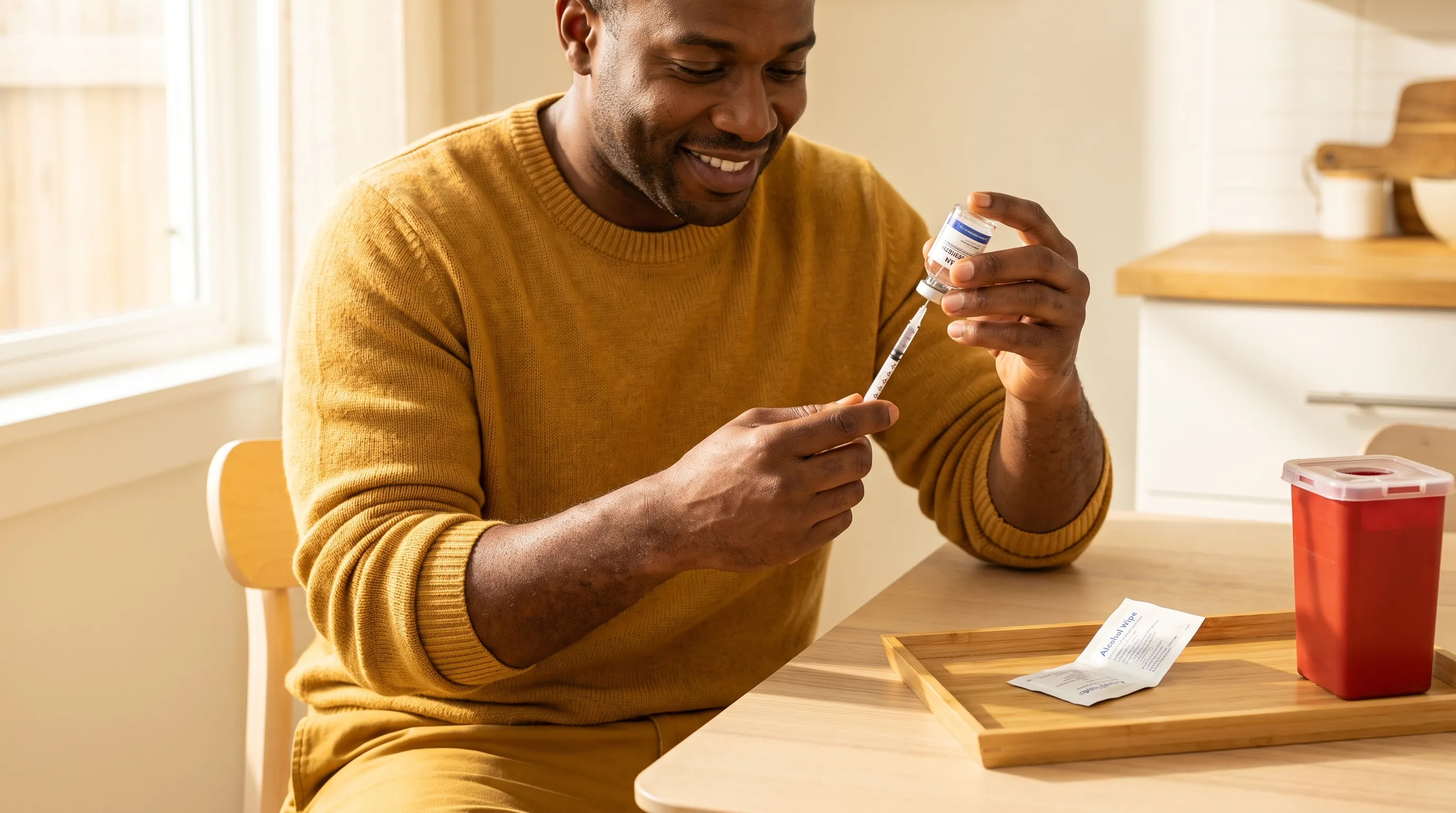
- 2. Set out your vial, a fresh insulin syringe, an alcohol pad, and your sharps container on a clean surface.
- 3. Wipe the vial's rubber stopper with alcohol and let it air-dry.
- 4. Pull air into the syringe equal to your dose, push it into the vial, then draw your exact prescribed dose.
- 5. Flick the syringe to move air bubbles to the top and gently push them out; recheck the dose.
- 6. Choose and wipe your injection site with a fresh alcohol pad; let the skin air-dry.
- 7. Pinch a fold of skin, insert the needle at 45 to 90 degrees in one smooth motion.
- 8. Push the plunger slowly and steadily until the dose is in.
- 9. Remove the needle at the same angle, release the pinch, and press gently with a clean pad (do not rub).
- 10. Drop the whole syringe straight into your sharps container. Do not recap.
What angle and depth to use
The right angle depends on your needle length and how much fat is at the site. A short insulin needle at a fuller site can go straight in at 90 degrees. A leaner site, or when you want to stay shallow, calls for 45 degrees. Pinching a fold of skin lifts the fat away from muscle so the dose lands in the subq layer, not the muscle.
| Situation | Angle | Tip |
|---|---|---|
| More fat at the site | 90 degrees | Straight in works with a short insulin needle |
| Leaner site or thin skin fold | 45 degrees | Shallower path keeps the dose in the fat layer |
| Unsure | Pinch and use 45 degrees | The pinch protects against going too deep |
If you hit muscleA deeper-than-expected stick can sting more but is rarely dangerous for a small subq dose. If you ever draw back and see blood in the syringe, remove it, use a fresh syringe and dose per your pharmacy's guidance, and pick a new site.
Rotating sites and staying safe
Injecting the same spot over and over can cause lipohypertrophy, hardened or lumpy fat that changes how the medicine absorbs. Rotating sites prevents this. Move to a new spot at least a finger-width from your last injection, and cycle across your abdomen, thighs, and arms over time.
- Keep a simple log or mental map so you do not repeat a spot too soon.
- Stay at least one finger-width from your previous site, and rotate across body areas over the week.
- Never inject into hard, dimpled, bruised, or sore tissue; let old sites fully recover.
- Watch for spreading redness, warmth, swelling, pus, or fever, and contact a clinician if they appear.
- Dispose of every needle in a sharps container; do not put loose needles in household trash.
For longer programs, see the peptide cycling guide and how to store peptides so your prepared vials stay stable between doses.
Common subq injection mistakes to avoid
Most problems come from rushing or skipping the clean steps. A few habits prevent nearly all of them.
| Mistake | Why it matters | Fix |
|---|---|---|
| Not letting alcohol dry | Wet alcohol stings on entry | Wait 10 to 15 seconds until dry |
| Reusing a needle | Dull, painful, higher infection risk | Fresh syringe every dose |
| Injecting the same spot | Lumps and uneven absorption | Rotate at least a finger-width away |
| Rubbing after injecting | Bruising and leakage | Press gently, do not rub |
| Guessing the dose | Under- or over-dosing | Read units carefully; follow your label |
Why the peptide you inject matters as much as the technique
Perfect technique cannot fix a bad vial. The biggest safety risk in this space is not the injection itself; it is grey-market "research-grade" or "not for human use" vials sold with no prescriber, no licensed pharmacy, and no verified identity, purity, or sterility. You have no reliable way to know what is really inside.
Pharmacy-grade compounded peptides are different. They are prescribed by a licensed physician and made by an FDA-regulated 503A compounding pharmacy that fills an individual patient's prescription. Compounded peptides are not FDA-approved, which is normal for compounded medicines: 503A pharmacies legally compound prescribed medicines that are not themselves FDA-approved. That status is about the approval pathway, not a verdict on quality. See why peptides aren't FDA-approved and research-grade vs pharmacy-grade for the full picture.
2026 regulatory noteOn April 15, 2026 the FDA removed 12 peptides from the 503A Category 2 list. The Pharmacy Compounding Advisory Committee (PCAC) reviews 7 of them (BPC-157, TB-500, KPV, MOTS-C, DSIP, Semax, Epitalon) on July 23 to 24, 2026. Removal from Category 2 is not approval and not yet placement on the authorized 503A list. Follow pru's 2026 FDA peptide coverage for updates.
How pru fits into safe injecting
pru is a telehealth platform for compounded peptides and closely related longevity therapies. You select what you're interested in, a licensed physician confirms it's an appropriate fit, and an FDA-regulated 503A pharmacy compounds and fills your prescription. That keeps your vial, your dose, and your instructions inside the legitimate path instead of the grey market.
- Physician-prescribed: a licensed doctor confirms clinical fit before anything ships.
- Pharmacy-grade: an FDA-regulated 503A pharmacy compounds your prescription.
- At cost: peptides are itemized with no markup on top of a flat membership.
- Verified: a Certificate of Analysis comes with every order, so you know what's in the vial.
Learning to inject well is part of taking charge of your own health, and that instinct is worth trusting. pru exists to make the informed, proactive choice the accessible one: licensed physicians, pharmacy-grade medicine, and at-cost pricing on one path. Browse the full catalog or explore by goal, from longevity and cellular health to muscle and performance and repair and regeneration. New to the process? Start with how to start peptide therapy or see pricing when you're ready.
Related reading
Keep learning the practical and safety basics with these guides.
- How to reconstitute peptides
- Bacteriostatic water guide
- Insulin syringe units guide
- How to store peptides
- Research-grade vs pharmacy-grade peptides
- Browse the pru catalog