GHK-Cu in 2026: A Plain Guide to the Copper Peptide
What GHK-Cu is, what the research supports, its two forms, and how pru dispenses it as a prescribed, pharmacy-grade cream at cost.
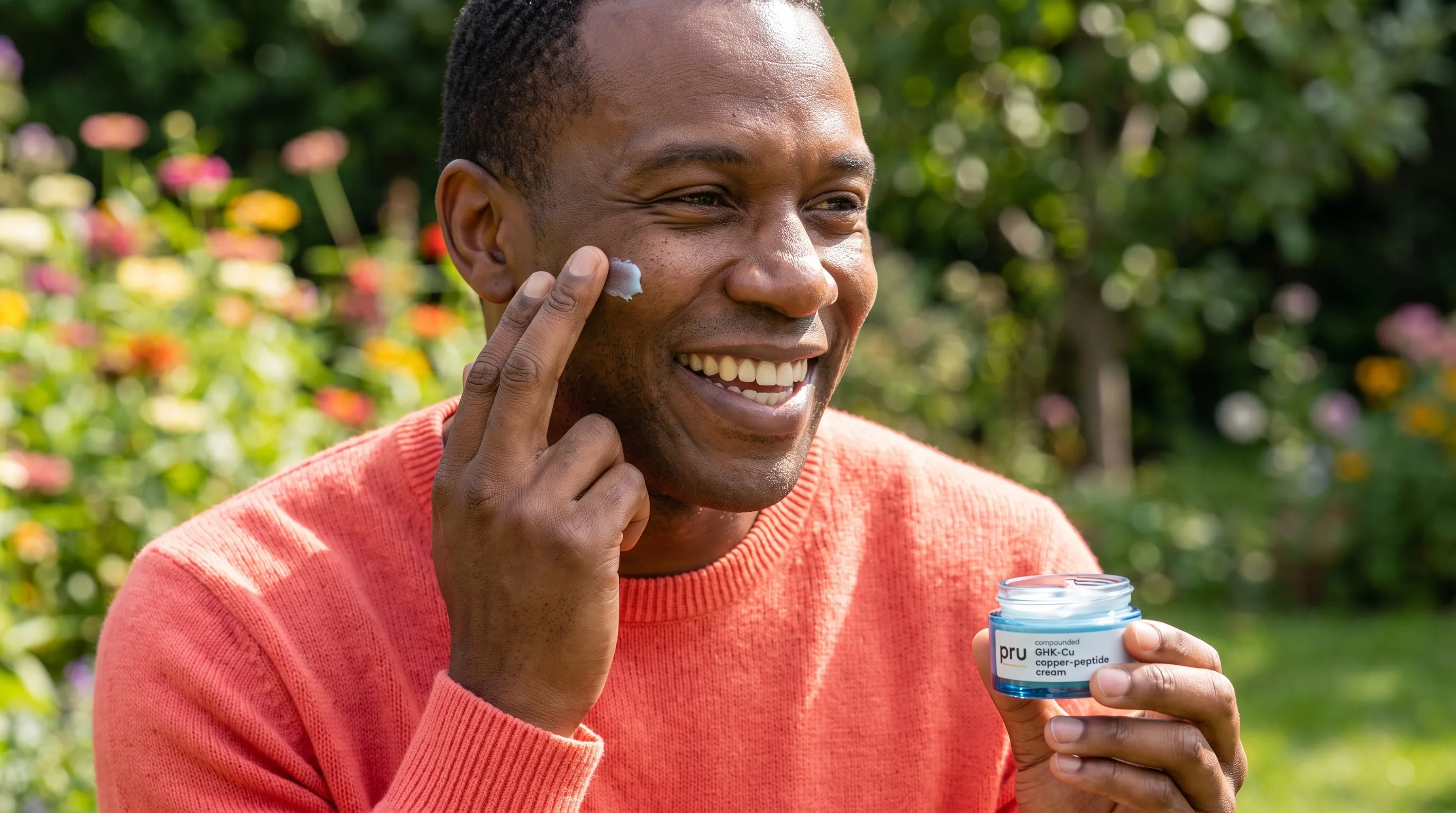
GHK-Cu is a small copper-binding peptide your body already makes. Looking into how to support your skin and tissue repair as you age is a smart, proactive move, and pru exists to make that informed choice an accessible one.
What GHK-Cu is
GHK-Cu is a copper complex of a three-amino-acid peptide: glycine, histidine, and lysine, written as glycyl-L-histidyl-L-lysine. The "Cu" is copper, which the peptide binds and carries. In cosmetic ingredient lists it appears as "copper tripeptide-1." It is a naturally occurring molecule, not a synthetic drug invented in a lab, though the material in any product is manufactured.
How popular is GHK-Cu?People search for GHK-Cu about 40,000 times a month in the US, a widely searched peptide, and search interest is climbing fast (2026 search data). See the Peptide Popularity Report for the full ranking.
Your body makes GHK on its own. It is found in blood plasma, saliva, and urine. Plasma levels decline with age. Published figures put the level at roughly 200 ng/mL around age 20 and about 80 ng/mL by age 60. Researchers have proposed that this drop is one reason tissue repair slows as people get older.
GHK-Cu is not a GLP-1 and has nothing to do with weight loss. It is also not on the World Anti-Doping Agency (WADA) prohibited list. For a broader look at copper peptides as a category, see the copper peptides overview.
How GHK-Cu may work
GHK-Cu is described in the research as a signaling peptide. Rather than acting like a nutrient the body burns for fuel, it binds copper and interacts with cells and genes involved in repair. The mechanisms below describe what the molecule is studied for.
- Collagen and skin matrix: in cell studies, GHK-Cu is associated with collagen and glycosaminoglycan production, the scaffolding that gives skin structure.
- Wound repair signaling: in animal wound models, topical GHK-Cu has been linked to faster closure and to growth factors involved in new blood vessel formation.
- Antioxidant and anti-inflammatory activity: in the lab, GHK has been shown to blunt certain copper- and iron-driven oxidation reactions and to modulate inflammatory signaling.
- Broad gene-expression effects: one widely cited review reported that GHK shifted the activity of a large share of human genes in cultured cells, which is why it is often described as a regulatory rather than single-target molecule.
Where the evidence is strongestGHK-Cu has a deep mechanistic base (cells and lab assays) alongside cosmetic human data (topical creams). The injectable form delivers the peptide into the body more broadly, and its systemic signaling rests on a solid foundation of animal and in-vitro work.
The two forms: topical vs injectable
GHK-Cu is used two very different ways, and the evidence and regulation differ sharply between them. A topical cream or serum acts mostly where you apply it. A subcutaneous injection puts the peptide into the body more broadly. Most of the consumer-level human data is for the topical form.
| Attribute | Topical (cream / serum) | Injectable (subcutaneous) |
|---|---|---|
| What it is | GHK-Cu in a skin-applied base | GHK-Cu in a sterile solution given under the skin |
| Where it acts | Mostly local, at the application site | More systemic, body-wide |
| Studied for | Skin firmness, fine lines, wound and barrier support | Repair and antioxidant signaling described in lab and animal models |
| Human evidence | The most consumer-level human data | Studied mainly in lab and animal models |
| Common OTC version | Copper-peptide cosmetic serums | Not sold as an approved consumer product |
| pru availability | Prescribed, 503A-compounded cream (pru's product) | Planned by pru once it can be prescribed through an FDA-regulated pharmacy; today largely research-grade or DIY |
Off the shelf, topical copper-peptide serums are sold as cosmetics without a prescription. Injectable GHK-Cu is a different story: it is often sold online as "research-grade" vials that are not intended for human use and are not quality-controlled for it, with no pharmacy vouching for identity, strength, or purity.
That grey-market route is the real risk, and it is exactly why the prescribed, pharmacy-dispensed path matters. The FDA's Pharmacy Compounding Advisory Committee is actively reviewing peptides, including copper peptides, in 2026, and that review is still ongoing. See the deeper GHK-Cu injection explainer for more.
Safety, side effects, and who should be careful
For the topical form, the most common issues are local: redness, itching, or mild irritation where it is applied. For the injectable form, the most common issues are injection-site reactions such as redness, soreness, or swelling. Copper is an essential mineral, but it is possible to get too much, so dose and quality matter, and this is one reason we keep GHK-Cu on a prescription rather than a buy-it-yourself model.
- Tell your clinician if you are pregnant, breastfeeding, or trying to conceive.
- Tell your clinician about any copper-related condition, such as Wilson's disease, or any active cancer or history of cancer.
- Share your full medication and supplement list, including other peptides.
- Stop and contact your clinician if you have a reaction beyond mild, short-lived irritation.
How GHK-Cu is typically used
There is no single universal GHK-Cu regimen, and dosing differs between the cream and the injection. Because dose depends on the individual and the specific compounded product, the authoritative instructions are the ones on your pharmacy label and from your prescribing clinician, not a number from the internet. Use the general shape below only to understand the format.
- Topical: cosmetic copper-peptide products are generally applied to clean skin on a daily or near-daily basis, following the specific product's directions.
- Injectable: subcutaneous protocols are dosed in small milligram amounts and cycled, but exact amounts, frequency, and length of use are set on the prescription and label.
- Follow the label first. If the label and any general guide ever disagree, the pharmacy label and your clinician win.
- Reassess with your clinician rather than extending or increasing on your own.
For a fuller walkthrough of how dosing is structured, see the GHK-Cu dosage guide. If you are comparing peptides across different goals, the best peptides by goal overview can help you frame the conversation with a clinician.

GHK-Cu and hair
Hair is one of the most common reasons people ask about GHK-Cu. GHK-Cu is studied for hair mainly in the context of the scalp environment: the same collagen, blood-vessel, and anti-inflammatory signaling that shows up in skin research is what researchers point to for follicles. In laboratory and early studies, copper peptides are associated with follicle support and with reducing signals that shrink follicles over time. GHK-Cu is not an established hair-loss treatment.
In practice, the copper-peptide products people use for hair are almost always topical, applied to the scalp, rather than injected. GHK-Cu is also different from the established hair-loss medicines. It is not minoxidil or finasteride, and it should not be treated as a replacement for a proven therapy or for a clinician's evaluation of why hair is thinning in the first place. If hair is your goal, that cause matters more than any single peptide.
GHK-Cu and hairCopper peptides are studied for the follicle environment, and the deepest human copper-peptide data is cosmetic skin data. If regrowing hair is the goal, that is a conversation for a clinician who can look at the actual cause and the proven medicines built for it.
What to realistically expect, and when
Any "before and after" schedule you see online is marketing, not clinical evidence. GHK-Cu is a signaling peptide studied over weeks to months rather than days, and its best-supported outcomes are cosmetic. Skin changes reported in topical studies are gradual, in the range of firmness and texture.

- Timeframe: any change is measured in weeks to months of consistent use, not overnight.
- Magnitude: the best-supported changes are cosmetic, especially for the topical form, which has the most human data.
- Consistency: the peptide is studied with regular, ongoing use rather than a one-time application.
The most useful thing you can do is set the goal with a clinician first and reassess against it, rather than chasing a timeline from the internet. If you want to think through goals across different peptides before that conversation, the best peptides by goal overview is a good starting frame.
GHK-Cu's legal and FDA status in 2026
GHK-Cu is not a conventional, mass-manufactured medicine in any form. Topical copper-peptide serums are sold as cosmetics, which are regulated differently from medicines and are not marketed for a specific medical result. The more important point in 2026 is about the injectable, compounded form and where it sits with the FDA.
In April 2026 the FDA removed GHK-Cu, along with 11 other peptides, from Category 2, the list of substances it had flagged for compounding-safety concerns. The topical form was placed in Category 1, meaning it can be compounded while the FDA completes its review.
For the injectable form, the FDA intends to consult its Pharmacy Compounding Advisory Committee before the end of February 2027 about adding it to the authorized 503A list. That is a real turning point. Keep the shape of it in mind, though: the committee only recommends, the FDA decides on its own over the months that follow, and a yes does not by itself put the injectable on the list. The door is opening, not open yet, and we keep GHK-Cu on a prescribed, pharmacy-dispensed path.
What this means for youA licensed clinician can prescribe GHK-Cu and a licensed 503A pharmacy can compound it today, while the injectable form goes through the FDA's formal advisory-committee review. pru's compounded GHK-Cu is pharmacy-grade, not an FDA-approved drug.
How pru handles GHK-Cu
pru is a telehealth platform focused only on peptides and longevity therapies. We work with licensed physicians and FDA-regulated 503A compounding pharmacies. The model is simple: you choose the peptide you want to start, guided by pru, and a licensed physician confirms it is appropriate for you, or advises against it, based on your health history and goals.
When GHK-Cu is a fit, that physician writes an individualized prescription and a 503A pharmacy compounds it specifically for you. Today, pru offers GHK-Cu as a topical, 503A-compounded cream, the copper peptide you rub on instead of inject.
It is a pharmacy-grade, prescribed product. With the topical form now in the FDA's Category 1 and the injectable form headed for Pharmacy Compounding Advisory Committee review, pru plans to offer the injectable form too as that pathway settles, the way pru does everything else: prescribed by a licensed physician and filled by an FDA-regulated, pharmacy-grade 503A pharmacy. That doctor oversight and pharmacy-grade quality is what pru prides itself on.
That is a deliberate contrast with the two common alternatives. Over-the-counter copper-peptide serums are convenient cosmetics but are not a prescribed, individualized product. "Research-grade" injectable vials sold online are not made or checked for human use, carry no pharmacy oversight, and sit outside the prescriber-and-pharmacy chain, which is the riskiest route, and never something pru would offer. pru's cream is a prescription filled by a licensed pharmacy, so you get a real prescription and pharmacy-grade quality instead of a grey-market vial.
Everything on pru is priced at cost under a flat membership of about $50 per month. We do not mark up the peptide, so what you pay for GHK-Cu is the actual pharmacy cost, not a retail margin.
Choosing to be proactive about how your skin and body repair is a responsible step, and pru's job is to make the prescribed, pharmacy-grade path the accessible one. When you are ready, you can see how the membership works on the pricing page, browse the repair and regeneration category, or look at GHK-Cu on pru.
Related reading
Common questions
Sources & further reading
- GHK Peptide as a Natural Modulator of Multiple Cellular Pathways in Skin Regeneration, PMC (PMC4508379)
- The Effect of the Human Peptide GHK on Gene Expression Relevant to Nervous System Function and Cognitive Decline, PMC (PMC6073405)
- GHK-Cu review, NIH National Center for Biotechnology Information (NCBI, PMC4508379)
- Compounding: Inspections, Recalls, and Other Actions, U.S. FDA
- GHK-Cu on pru, joinpru.com
- FDA Announces Removal of 12 Peptides from Category 2 and Schedules PCAC Meetings to Consider Adding Peptides to 503A Bulk Drug Substances List, Orrick (2026)
- Certain Bulk Drug Substances for Use in Compounding that May Present Significant Safety Risks, U.S. FDA